For a long time, I thought I had a discipline problem.
I would make plans and not follow through.
Start projects and leave them unfinished.
Ignore text messages. (Apologies to anyone reading this who currently lives in my collection of 46 unread text messages. I’m still working on this one.)
Leave things sitting on my to-do list for weeks.
Tell myself I was going to work out tomorrow.
Then somehow tomorrow would become next week.
If you’ve ever looked around your house, your inbox, your laundry pile, or your life in general and thought, “Why can’t I just get it together?” you’re not alone.
I think a lot of us are walking around calling ourselves lazy.
But lately I’ve been wondering something.
What if we’re not lazy?
What if we’re overloaded?
Overload doesn’t always look the same.
For some people it’s raising kids.
For some it’s work.
For some it’s caring for aging parents.
For some it’s financial stress.
For some it’s trying to keep everybody else happy while quietly ignoring themselves.
Different circumstances.
Same feeling.
You sit down at the end of the day knowing there are things you should do.
And yet somehow you can’t seem to make yourself do them.
Not because you don’t care.
Not because you’re lazy.
Because you’re exhausted.
For me, overload rarely looks like doing nothing.
It usually looks like doing one thing really well.
For example, when work gets busy, I usually rise to the occasion. My clients get called. Emails get answered. Projects move forward. Goals get hit.
But by the time I log off for the day, it’s like I’ve spent my entire battery.
That’s when the other things start piling up.
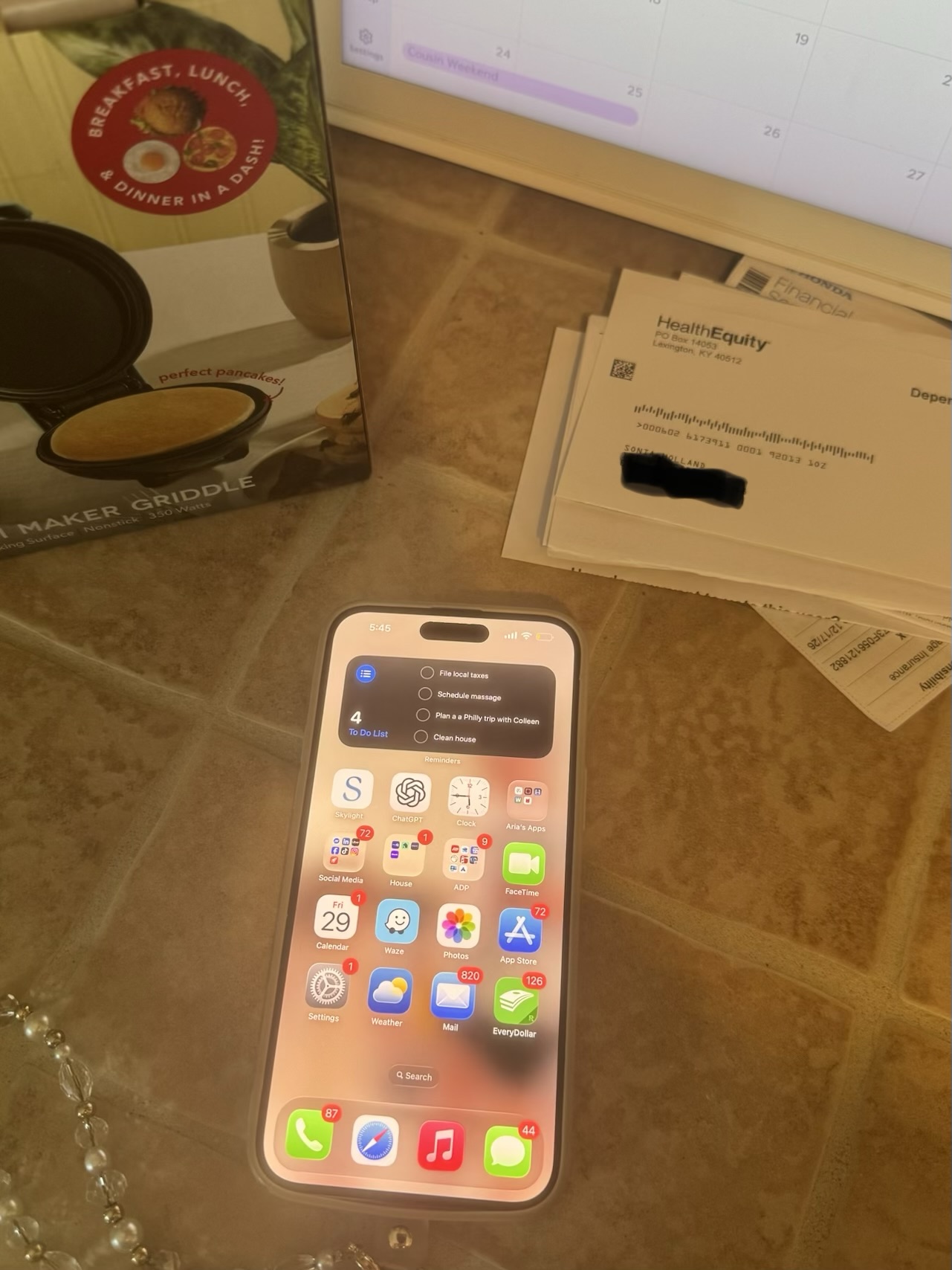
The 46 unread text messages.
The healthy eating plan I was definitely starting on Monday.
Then my 9 p.m. DoorDash order arrives and I decide Future Sonia can handle that problem.
She’s been handling it every Monday for about six weeks now.
The mini pancake griddle Amazon return that’s currently living on my kitchen counter.
The pile of mail I keep moving from one surface to another as if changing its location somehow counts as progress.
Before we go any further, I’d like to submit Exhibit A into evidence.

At the time of writing this post, I had:
- 820 unread emails
- 46 unread text messages
- 87 unread voicemails
- A mini pancake griddle waiting to be returned
- A pile of mail that has apparently become part of my home’s permanent decor
- A DoorDash order arriving because apparently Future Sonia wasn’t cooking either
- A growing to-do list with no end in sight
But sure.
Let’s go with lazy.
It’s not that I don’t care about those things.
It’s that somewhere along the way, I ran out of bandwidth.
I’ve noticed I can usually keep all the balls in the air for a little while.
The problem is eventually gravity wins.
The older I get, the more I realize that being overloaded can look a lot like laziness from the outside.
You stop returning calls.
(Guilty. Apologies to my friends and family. Luckily they’re used to it by now.)
You stop doing things you enjoy.
You put things off.
You procrastinate.
You feel stuck.
Then you beat yourself up for all of it.
Because the world has convinced us that the answer is always more discipline.
Wake up earlier.
Work harder.
Be more productive.
Get organized.
Download another app.
Make a list of all the things you need to do and somehow convince yourself that making the list counts as being productive.
But what if the problem isn’t that you’re bad at carrying things?
What if you’re carrying too many things?
That feels different.
One requires fixing yourself.
The other requires being honest about how much you’re carrying.
I think that’s why so many people feel guilty all the time.
We’re measuring ourselves against a version of life that doesn’t actually exist.
The version where we’re productive at work, fully present at home, physically healthy, emotionally healthy, organized, rested, available to everyone, and somehow still have energy left over.
That’s a lot.
Maybe too much.
I’m not saying discipline doesn’t matter.
It does.
There are absolutely situations where the answer is more consistency, more effort, or simply doing the things we know we should be doing.
This isn’t about avoiding responsibility or excusing bad habits.
It’s about recognizing that sometimes the problem isn’t a lack of discipline.
Sometimes the problem is that you’re already carrying so much that even the smallest tasks start feeling heavy.
Those are two different problems.
You can become incredibly disciplined and still be carrying too much.
Maybe that’s why so many of us feel like we’re failing when we’re actually just tired.
Maybe that’s why things that used to feel easy suddenly feel hard.
Maybe we’ve been asking ourselves the wrong question.
Not:
“How do I become more productive?”
Not:
“How do I squeeze more into my day?”
Not:
“How do I become better at carrying everything?”
But:
“What am I carrying that no longer belongs on my plate?”
Because there comes a point where the answer isn’t another productivity hack.
Sometimes the answer is reducing the load.
Maybe that’s why we’re constantly trying to improve ourselves instead of asking what needs to come off our plate.
Maybe you’re not lazy.
Maybe you’ve just been carrying too much for too long.
Maybe the answer isn’t becoming a more efficient version of yourself.
Maybe the answer is putting something down.
👉 Read next: Why High Functioning People Ignore Their Own Needs


One thought on “Maybe You’re Not Lazy. Maybe You’re Overloaded.”